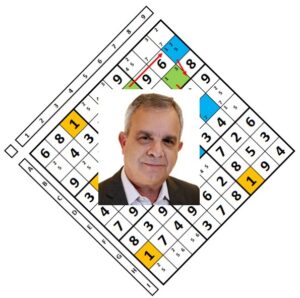
Coloring is a way to observe how numbers behave in a certain set of rows, columns, or boxes.
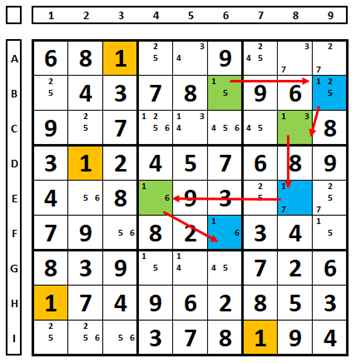
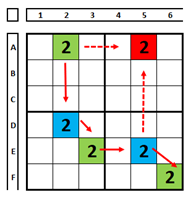
The technique requires the crossing of theconjugate pairs formed in each UNIT, see the table below for the number “1”. The yellow cells are the clues left by the Sudoku author. In row B, the number “1” is only present in cells B6 and B9 and one will belong to the Sudoku solution. Each one is marked with a color (in this case green/blue, but they could be any other, to the reader’s liking). The technique is to alternate the two colors as the pairs of numbers in each row, column, or box are followed.
There are pairs formed in box 3 (B9/C8), column 8 (C8/E8), row E (E4/E8), and box 5 (E4/F6).
In the solution of this Sudoku, the cells marked in green or blue are the correct solution for the number “5” in the above Sudoku. This concept is very important.
First Deduction
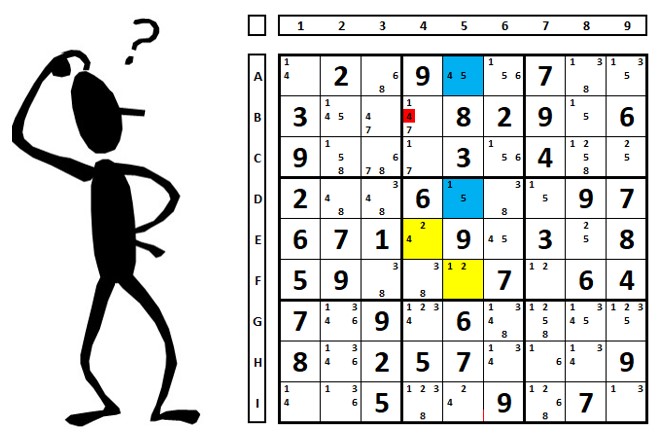
According to the concept above, either the green or blue set will contain the correct solution for the number “5” in the Sudoku above. This concept is very important. Since the blue set appears twice in column 5, it cannot be the solution, so all numbers located in the cells marked in blue must be eliminated.
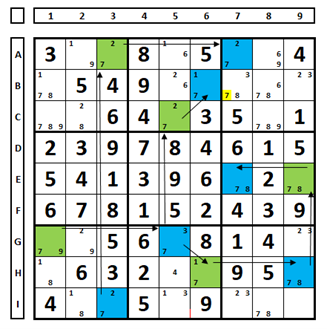
Examining the number “7” (starting at G1): as there are two “7” numbers marked in blue (A7 and E7) in column 7, the blue set can be excluded from the solution, the “7” number marked in yellow is the solution, as well as all the “7” numbers in the green set.
If two numbers share the same color in the same UNIT, this group (color) is false for the entire Sudoku – very important. In the example above, column 7.
Segunda dedução:
Conforme o conceito acima ou a série verde ou a azul conterá a solução do sudoku. O número “2” na célula A5 enxerga as duas séries (verde em A2 e azul em E5) logo pode ser excluído.
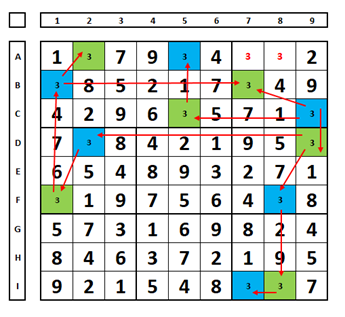
Example. The number “3” was highlighted in the Sudoku below. The number “3” in cell C9 was marked in blue. From there, the other “3” numbers that formed a pair within a row, column, or box were alternately marked in blue and green.
Either the green series or the blue series belongs to the solution of this Sudoku.
In row 1, both blue and green series appear and one of them belongs to the Sudoku solution, therefore the red-marked “3” numbers can be excluded. The same conclusion applies to columns 7 and 8.
If a number can see both series, it can be excluded from the cell. Very important.
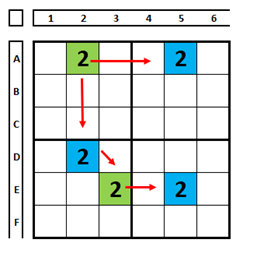
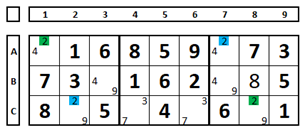
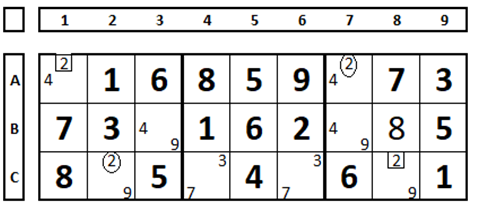
Is it difficult to color? Use symbols instead of colors:
This technique should be used with great care, between conjugate pairs in rows, columns, or boxes, otherwise it can lead to incorrect results.