In a Death Blossom, there is a cell called the stem cell that has only two candidates. One candidate shares a unit with the fin of one ALS, and the other candidate shares a unit with the fin of another ALS. Then, if both ALS cause the elimination of a single candidate, that candidate can be eliminated because either of the stem cell values will eliminate it.
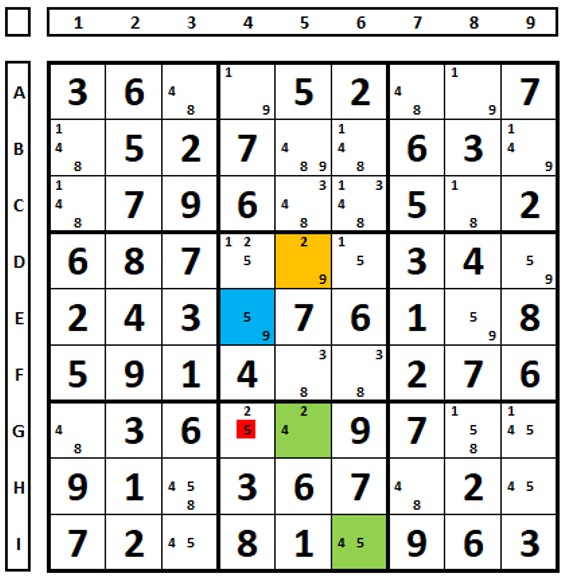
Going straight to a simpler example. In the Sudoku below, the center of the flower (stem cell) is the cell marked in brown, which sees the petals marked in blue and green. The numbers in the brown cell have a common restricted number (RCC) with each set. The number “2” (D5) is common restricted with the green set, and the number “9” (D5) is common restricted with the blue set. The number “5” in G4 sees all the “5” numbers in the “petals” and can be eliminated.
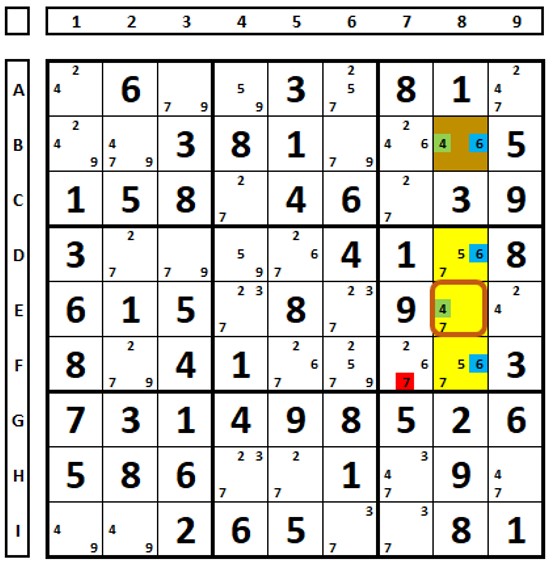
This is a very peculiar example. As mentioned before, there is no impediment for two ALSs to share two cells in common. The center of the flower (brown cell) sees two ALSs, the yellow one (D8, E8 and F8, with RCC = 6) and the one circled in brown (cell E8 with RCC = 4). There is no impediment for one to be contained within the other, as long as the RCCs that connect them to the center of the flower (B8) are different. The number “7” in F7 can be eliminated, as it sees both “7” numbers in the two petals.