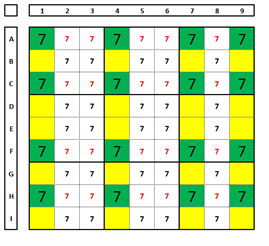
A variant of Swordfish, in four rows or columns. Below is a classic Jellyfish, where columns 1, 4, 7, and 9 have the number “7” in green positions. Choosing one of the “7” numbers when solving Sudoku will force the solution of the others. All “7” numbers that are between two “green” cells can be excluded.
Just like the Swordfish, finding this formation is extremely difficult, but it is possible to find 2x2x2x2x, 3x2x3x3, etc.
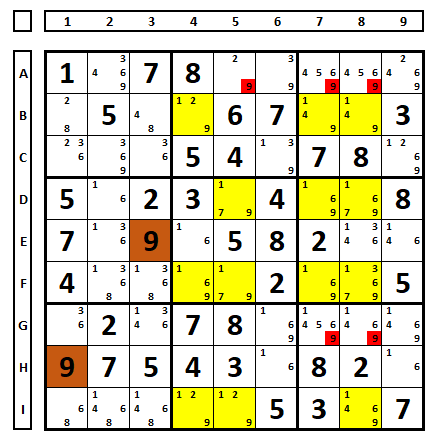
3x3x4x3 Formation. In the Sudoku below for number “9”. In the cells marked in yellow, this number occurs only in 4 rows (B, D, F, I) and in four columns (4, 5, 7, 8). The solution for this number will be in these cells. The marks in red can be excluded.
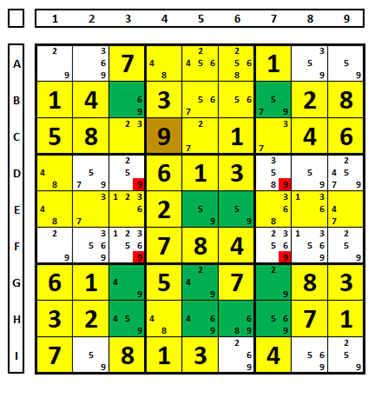
Example of formation 2x2x3x4. The cells without the number “9” have been marked in yellow for better visualization.
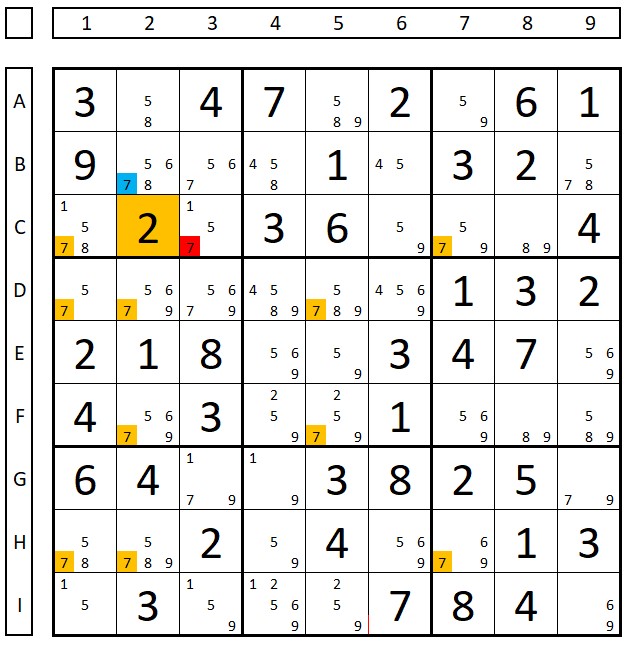
Like Swordfish, Jellyfish allows finned and sashimi solutions. Review concepts in the Swordfish technique. In the Sudoku below, for the number “7”, there is a jellyfish in columns 1, 2, 5 and 7 (base set) and in rows C, D, F, and H). There’s a jellyfish sashimi, which allows deletion marked in red. If the number “7” is a solution in cell B2, delete it in cell C3. If it is not a solution, the traditional jellyfish will be formed with the same elimination.
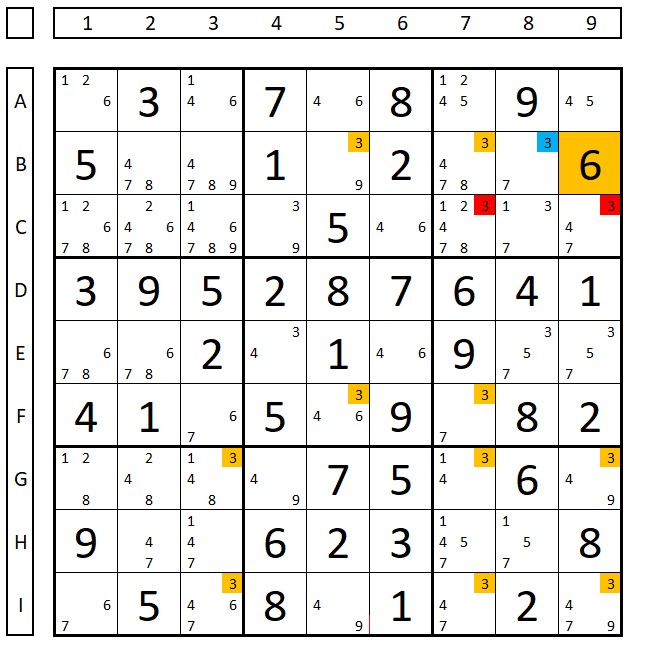
Another example. In the sudoku below for the number “3”. Base set rows B, F, G and I. Cover set columns 3, 5, 7 3 and 9. Fin in blue cell. IF the blue cell is a solution, eliminate the two in red, if not, we will have a classic jellyfish with the same eliminations.