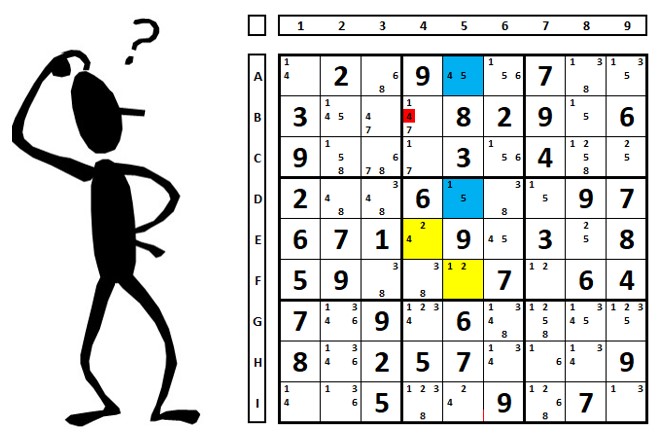
When two conjugate pairs of a number (in a row and a column), perpendicular to each other, cross in a box, the cell located at the intersection of the tips of these pairs can be excluded.
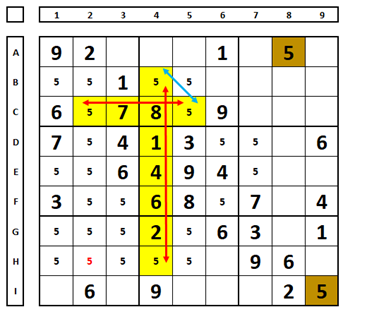
Example: In the sudoku below, looking at the possibilities of the location of the number “5”. There is a conjugate pair formed by C2/C5 and another formed by B4/H4, which cross perpendicularly in box 2. For any choice made for the number “5” in box 2, the number “5” in cell H2 will be excluded.
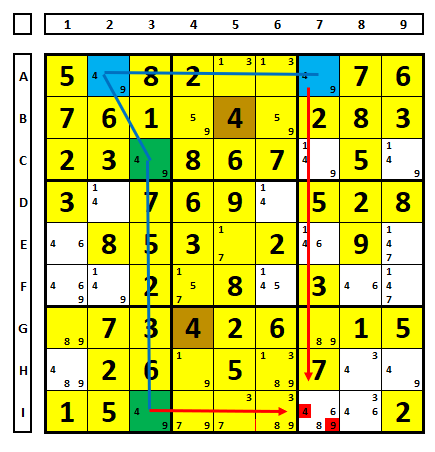
Another example. For any choice made in box 3, the number “3” in A1 or G8 will belong to the Sudoku solution, confirming the exclusion in G1.
Another example: the same occurs with bi-value cells, since the numbers (in the case below “4” or “9”) individually behave as above. See Remote Pairs ahead.