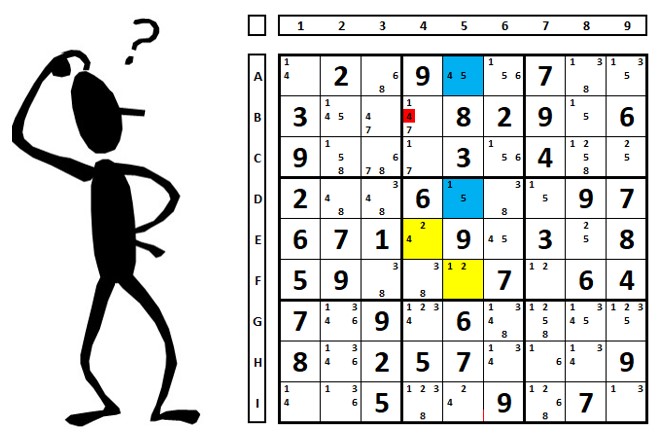
The name Sudoku was given to the game in Japan, and consists of the combination of the Japanese characters “Su”, which means “number”, and “Doku”, which means “unique” (WILSON, 2006).
Despite its name, Sudoku was not a Japanese invention. It has roots in ancient number puzzles, in particular, in magic square arrangements (WILSON, 2006).
A magic square is an arrangement of distinct natural numbers, in a square matrix of size N × N. In it, the numbers in each row, column and in the main and secondary diagonals, result in the same value when added, a characteristic resulting from the use of the same set of numbers that are not repeated for all lines. Magic squares of any dimensions can be constructed, with the exception of 2 × 2, which is an impossible case.
The 1 × 1 magic square is trivial. The smallest non-trivial square is the one with dimensions 3 × 3 (WILSON, 2005). The great Swiss mathematician Leonhard Euler is credited with creating the foundations of the game we know today as Sudoku (WILSON, 2006).
Perhaps just as a hobby, Euler developed the basics of the game, which he called Latin Squares. Euler modified the original rules of the magic square, limiting the number of digits used to N – the size of a line or column of the grid –, removing restrictions on diagonal sums and starting to require distinct digits only in lines and columns, instead of the whole grid. Euler realized that the rules for sums in rows and columns would always be satisfied due to the restriction of using the same set of N digits. He then used letters as symbols, instead of numbers, making the game a combinatorial analysis problem (WILSON, 2005). His ideas on the subject were published in 1782.
The current format of Sudoku was proposed by Howard Garns, an American architect, who added to the problem of the Latin square 9 × 9 the restriction of unique numbers in the 9 regions of size 3 × 3 that compose it. The first sudoku puzzle was published in 1979 by Dell Magazines, under the name of Number Place (WILSON, 2006). The game was introduced in Japan by Nikoli, in the Monthly Nikolist magazine, in April 1984, under the name Sudoku (WILSON, 2006). It soon became a very popular pastime in the country. However, success was restricted to Japan, and Sudoku did not manage to attract the same attention in the West until the end of 2004. It was when The Times of London published its first Sudoku, on November 12 of that year (WILSON, 2006 ). The game then became a worldwide phenomenon.
WILSON, R. How to Solve Sudoku: A Step-by-Step Guide. 1st ed. [S.l.]: Infinite Ideas, 2005. 124 p. ISBN 1904902626.
WILSON, R. The sudoku epidemic. Focus, v. 26, no. 1, p. 5–7, 2006.
History taken from the conclusion work of “Thiago Zanivan Felisberto”, from UNIVERSIDADE FEDERAL DE SANTA CATARINA CAMPUS ARARANGUA, in the conclusion work entitled “ROBÔ SOLUCIONADOR DE SUDOKU, December 2015”.