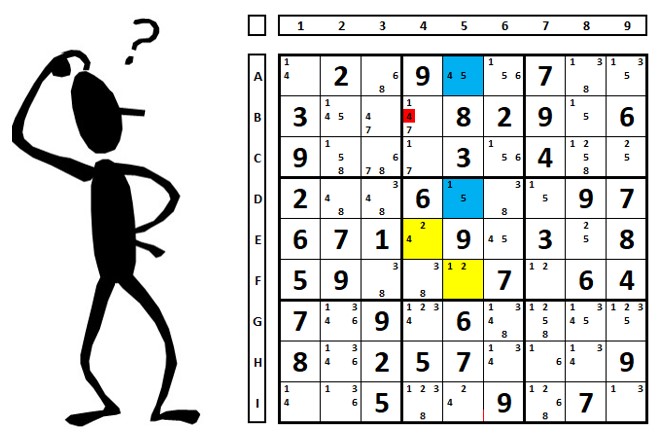
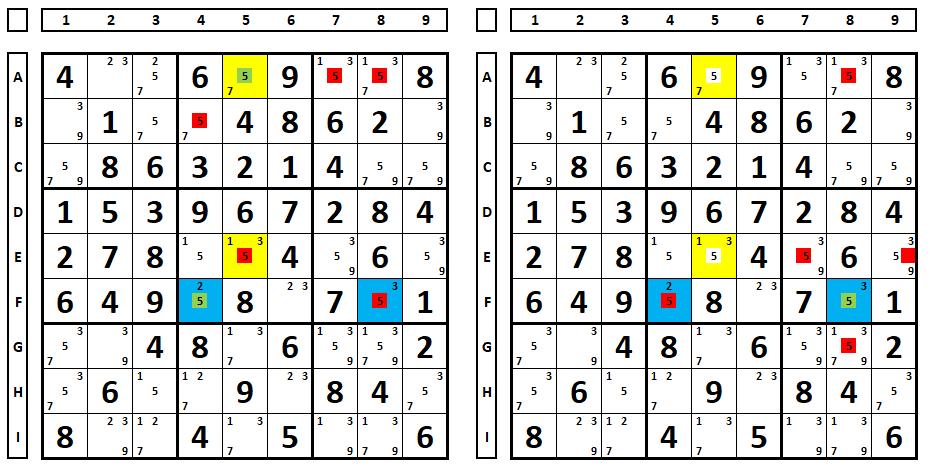
Similar to the previous one. Within a box, two ‘perpendicular’ pairs intersect without sharing any cells in common. The candidates that see both ends can be eliminated. Be careful, the cells inside the box (in this case, B1 and C2) are not ends, otherwise, the number “6” in B6 could be excluded as a candidate.
Another important thing to note is that within the intersecting box, the candidates will only occupy two cells. In the case below, the number “6” occupies only cells B1 and C2 in box 1.
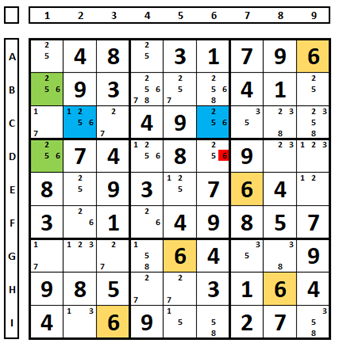
Another example: for the number “7”:
Always alert
Many times when trying to solve Sudoku using a certain technique, it doesn't work, so check if there are no other conclusions to be drawn, let's call this "extra-technical tip".
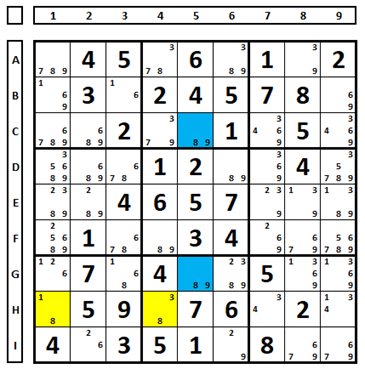
Always on the lookout for variations in technique. In the Sudoku below, you cannot use the Two-String Kite technique, as there is a third element for the number “8” in box 8 (cell G6):
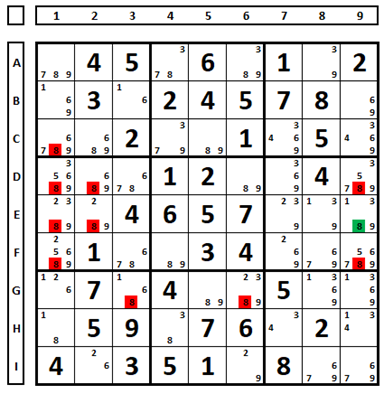
But, if the reader tests (considers the solution number “8” in H1 and then in H4), he will have the following eliminations (in red) and solution (in green) in common (try). Thus, a very difficult sudoku puzzle becomes a relatively easy sudoku puzzle.
Another example, for the number “5”. Parallel pairs (green and blue cells). Any choice in the blue cells eliminates the number “5” in cell A8.