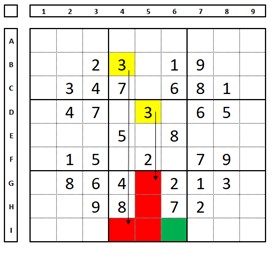
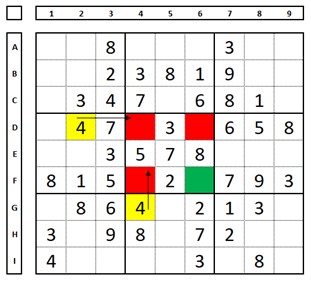
When only one number can be placed in a cell based on the position of that same number in the columns, rows, or boxes. In the example below, in box 8, the number “3” can only be in the “green” position, as it cannot occupy the cells in “red,” since the number “3” already occupies columns 4 (cell B4) and 5 (cell D5).
Still in the same example, examining the number “3” in cells C2, G8, and I6:
Examine the remaining possibilities for the number 3. It will be possible to complete the number "3" in all boxes.
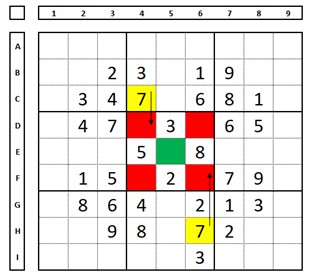
Another example, the number “7”:
Continuing with this Sudoku. Evaluating all the possibilities of intersection (row/column) from “1” to “9” (try it before moving forward):
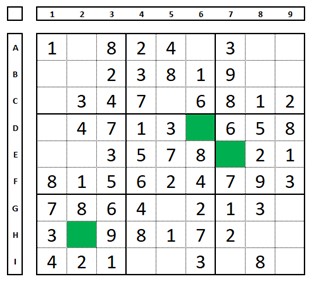
In this “first pass” evaluating all the possibilities of placing the numbers from “1” to “9”, new numbers were inserted into the original Sudoku, in addition to the clues given by the Sudoku author, but it is worth doing a “second pass.”
Looking at the number “4”: in the first pass, it could not be placed in box 5. Now this is possible:
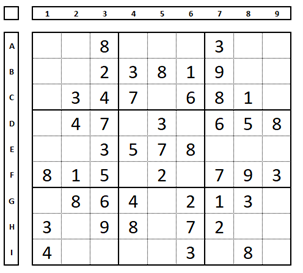
With the “second pass,” it is possible to get to this point, just by crossing the numbers in the rows and columns (try to do it before continuing reading). Which numbers complete boxes 5, 6, and 7? Try to finish solving the Sudoku, if you can’t, don’t give up, simple techniques ahead will show you how to complete it.
It is recommended to redo the “passes” (row/column/box intersection) until it is no longer possible to find a solution from this technique, and then move on to others.