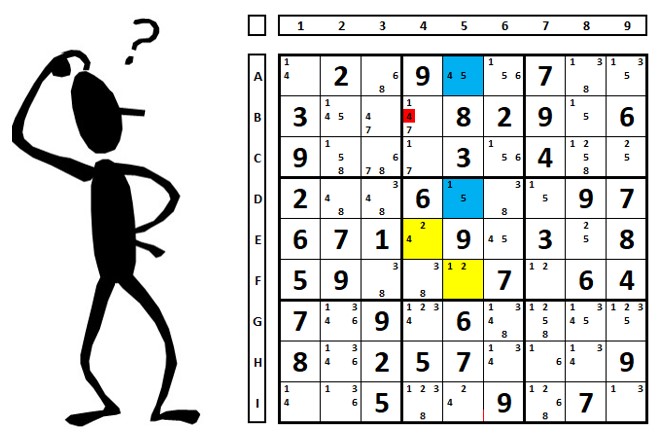
The secret of this technique is that the total number of cells must be equal to the number of candidates in all cells. With this, there is a set of “x” blocked cells. There is a basic rule: look for the intersection of a row (or column) with a box. In the box, find two cells (set A) with four candidates or three cells with five candidates (the cells must be in the row that follows outside the box). In the row (or column), outside the box, find a bi-value cell that contains the numbers of “set A”, and in the box, find another bi-value cell with the numbers of set A, but different from the bi-value cell in the row (or column). The candidates of other cells that see ALL the candidates above can be excluded.
In the sudoku below, there is a set of green cells, with the numbers (2,3,4,8). This set sees the yellow cells that contain different candidates (F4: 3,8) and (I5: 4,2), which are candidates that are in the green set. Four cells containing four candidates, forming a locked set. The numbers marked in red see all of the locked set and can be excluded. It’s time to learn how to see, what happens by choosing candidate 2 or 4 in cell I5?
Another example, with 3 cells in the intersection and 5 candidates:
Type 2:
In the Sudoku below, the rule applies to row F (the row and its intersection). The candidates (4,7) in cell F4 are present in the intersection set in box 6. The number “2” in cell E9 meets the condition of having candidates in the green set, but adds a number “5” that is not in the green set. Adding cell D9, with the candidates that are in the green set and that have the number “2”, completes the set of five candidates in five cells, allowing the numbers marked in red to be excluded.
Type 3:
In the sudoku below, there is a locked set in the green cells (3, 4, 7, 8, and 9). The numbers “7” and “9” in cell G2 can be excluded because they see the same numbers in the green set.