It is worth discussing a little about strong and weak links.
Go back to the beginning of this book and review the definitions of strong and weak links.
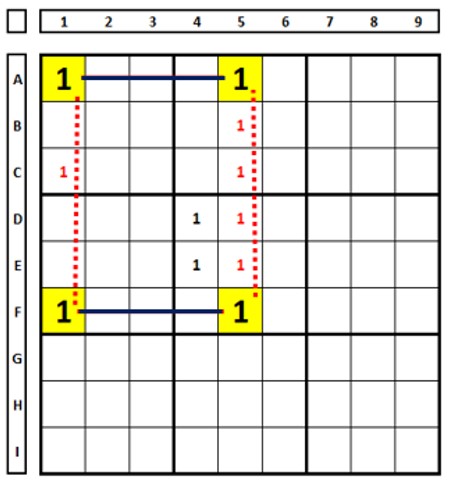
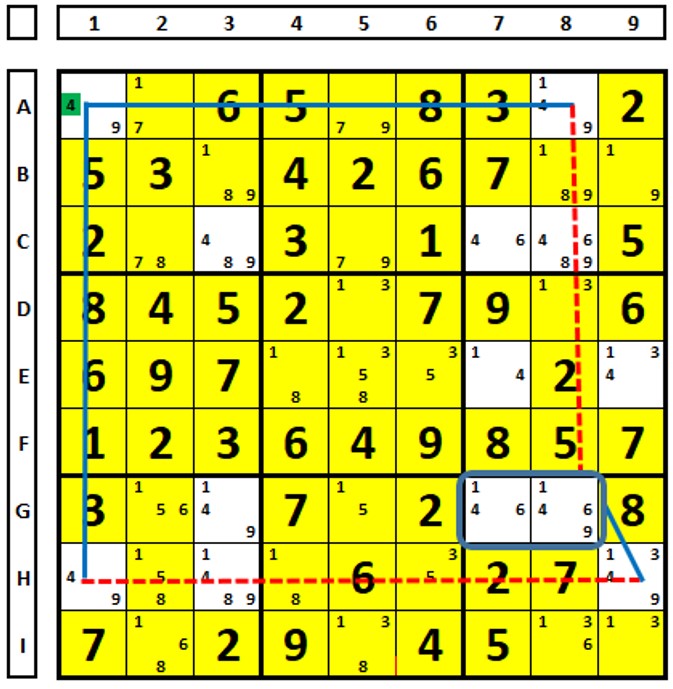
Demonstrating with an X-Wing. In an X-Wing there are strong and weak links.
It is easy to demonstrate that for any choice we make in the strong links below A1/A5 and F1/F5, the candidates marked in red can be excluded from the row or column (connected by the weak link). This is regardless of not knowing the solution of the X-Wing.
In other words, the candidates located in the weak links, which are not part of the X-Wing (strong links), can be excluded. PAY ATTENTION, candidates located at the ends of the weak links are not excluded, they are part of the strong links.
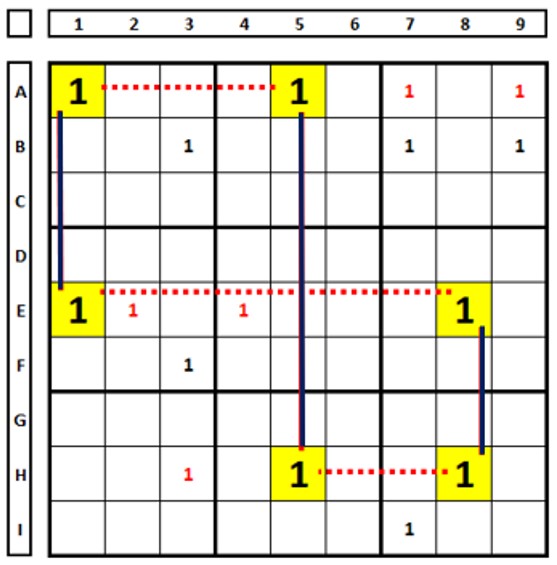
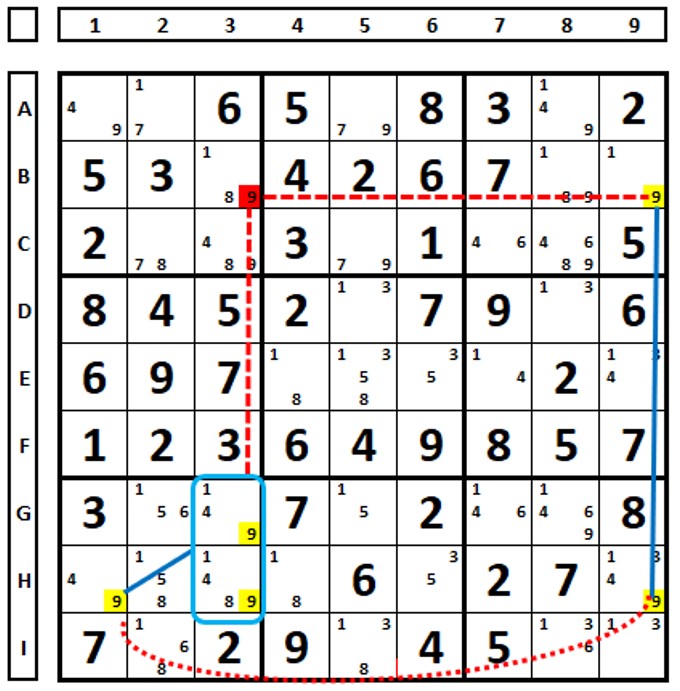
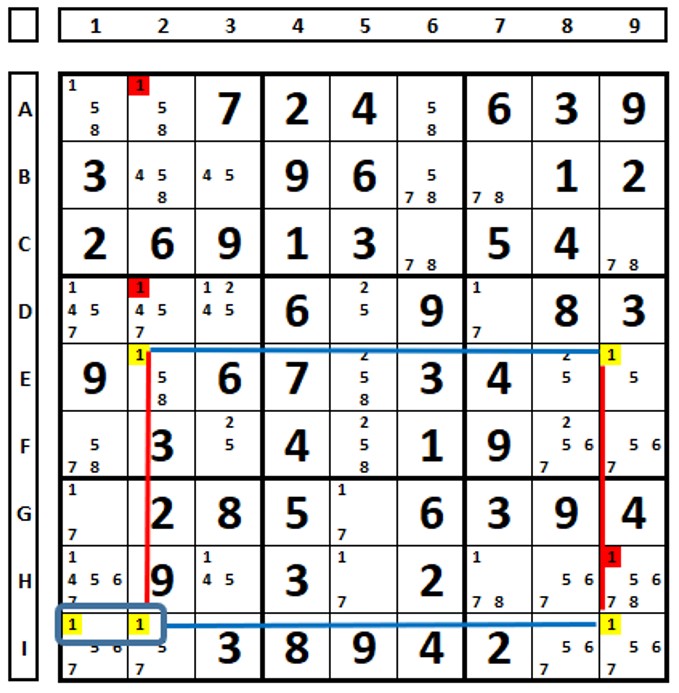
In a Swordfish, the same thing happens:
An X-cycle is a closed chain of the same number, joined by strong and weak links, that alternate in various ways.
X-Cycle – Nice Loop 1
Eliminates numbers outside the chain. When there is a chain of candidates joined by weak and strong links in sequence, all the same candidates in the UNITS, which do not belong to the chain, can be excluded.
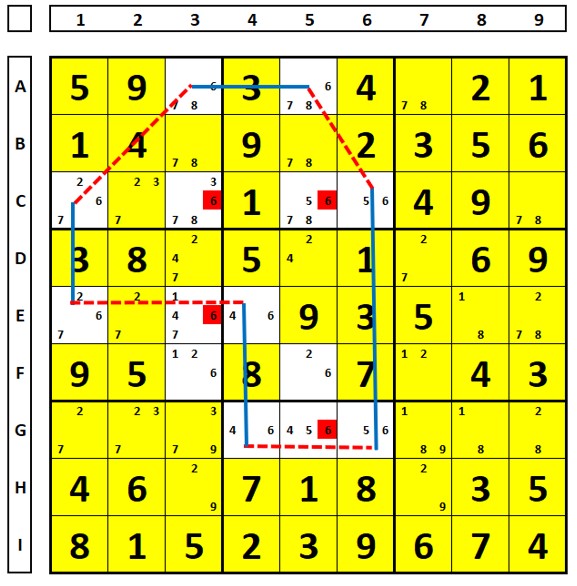
In the sudoku below, there is an alternation of strong and weak links for the number “6”. In the units (Box 1, 2 and 8 and row E) where the weak link crosses, this number can be excluded.
X-Cycle Nice Rule 2
Acts on the chain. It is a discontinuity in the cell that does not maintain the sequence of strong links followed by weak links. The cell that has two strong links is the discontinuity. And this cell contains the solution to the Sudoku.
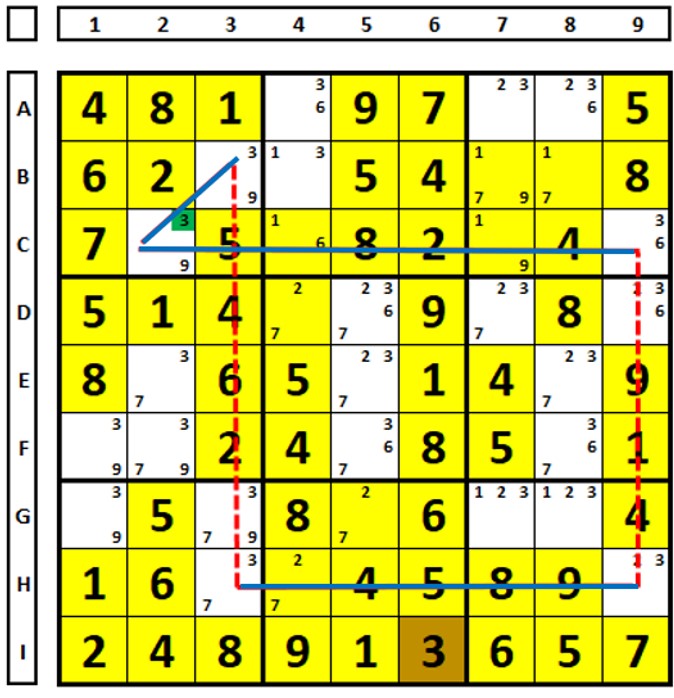
In the Sudoku below, examining the number “3”, the discontinuity is in cell C2, the number “3” is the solution in this cell:
Acts on the chain. It is a discontinuity in the cell that does not maintain the sequence of strong links followed by weak links. The cell that has two strong links is the discontinuity. And this cell contains the solution to the Sudoku.
In the Sudoku below, examining the number “3”, the discontinuity is in cell C2, the number “3” is the solution in this cell:
Nice Loop Rule 3
Acts on the chain. The cell that does not maintain the sequence of strong links followed by weak links is the discontinuity. The cell that has two weak links is the discontinuity. And the candidate in this cell can be excluded.
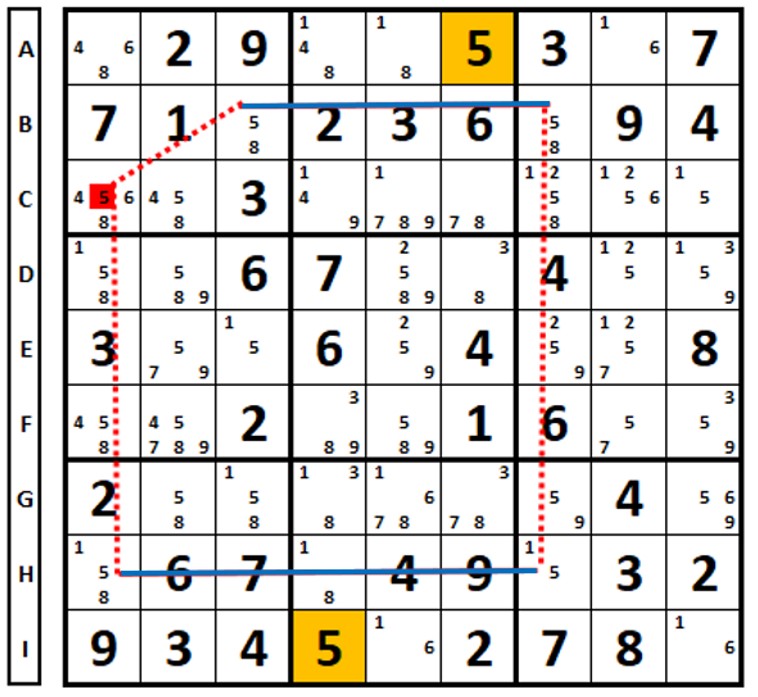
In the example below, for the number “5”, the discontinuity is at the break in the sequence (strong/weak links) that occurs in cell C1, allowing the “5” in this cell to be excluded:
Strong links can be weak links
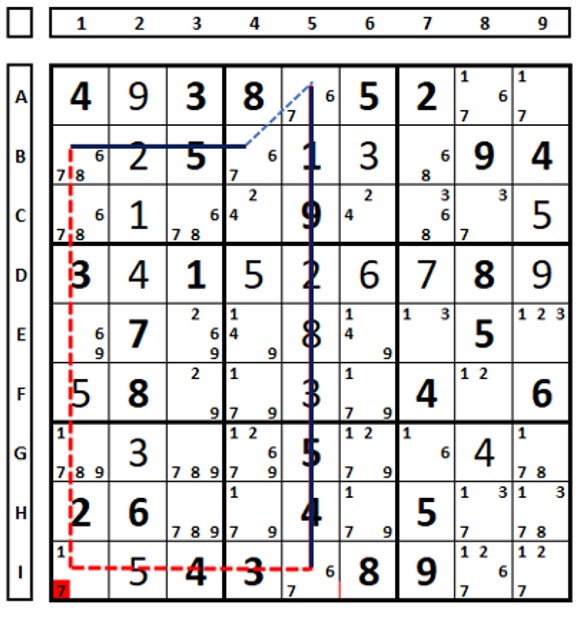
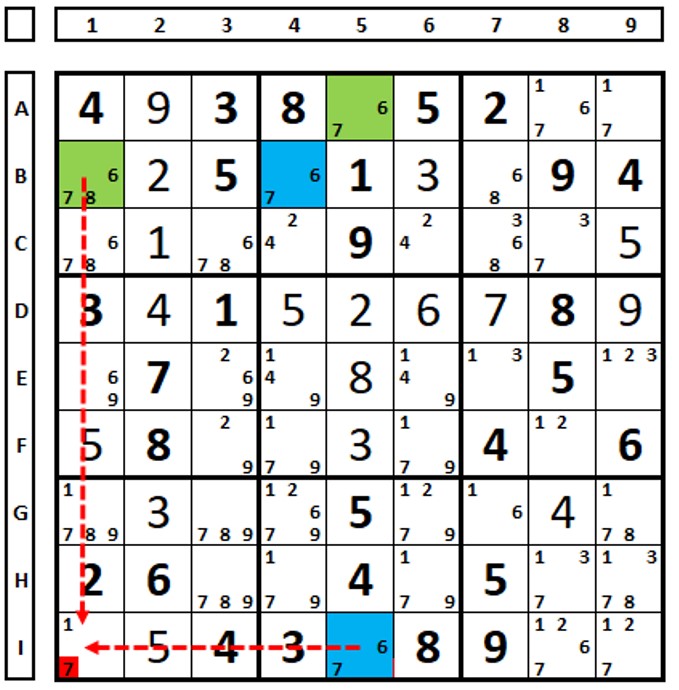
The strong link between cells B4/A5 for the number “7” has been “transformed” into a weak link (blue dotted line) to continue the weak/strong cycle and ensure the rule of meeting the two weak links in I1. Weak links cannot be used as strong links.
Demonstrating by the colorimetric method:
Another slightly more complex example.
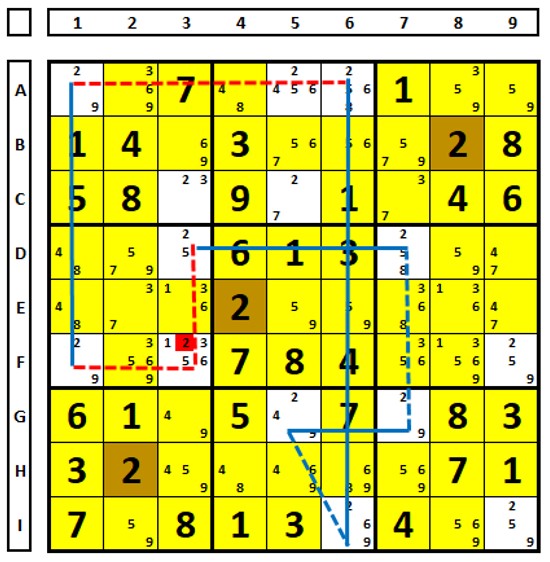
In the Sudoku below, the blank cells show the possible locations for the number “2”. The dashed blue lines show strong links, which when “transformed” into weak links, allow the cycle below to be constructed and exclude the number “2” from the union of two weak links in cell F3.
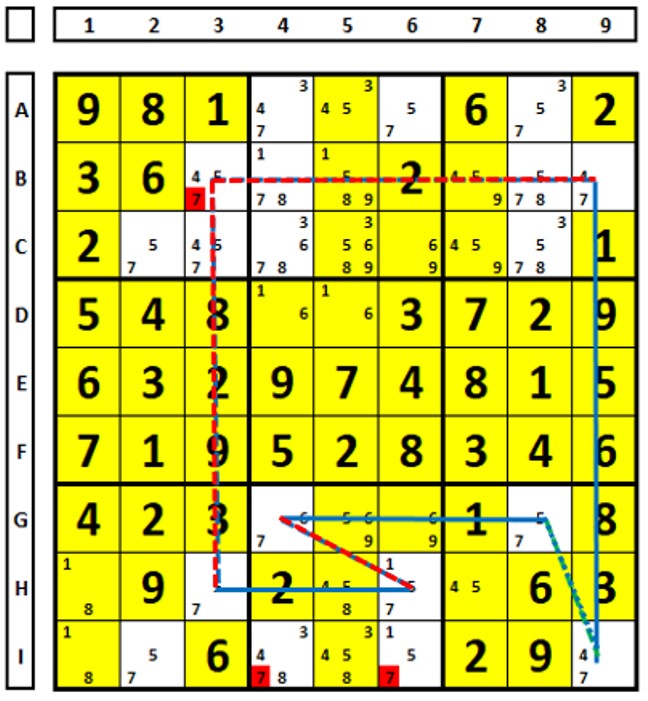
Another example: by transforming the strong link G8/I9 into a weak link, it is possible to exclude the number “7” in B3 and in I4 and I6:
Grouped X-Cycles.
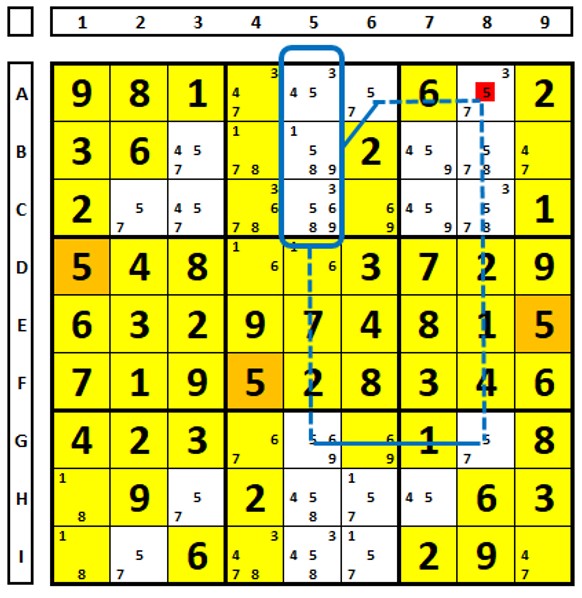
Examine the Sudoku below, the number “5” is being linked, by strong and weak links, to a group formed by the set A5, B5, and C5.
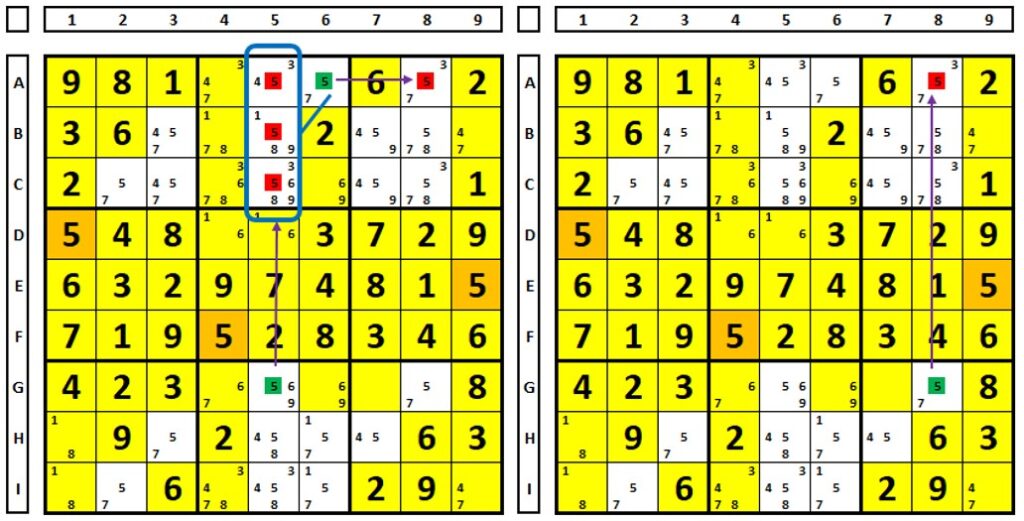
Demonstration: for any choice made (G5 or G8), the number “5” in A8 will be excluded.
Other examples.
Don’t forget the rules of elimination for row/column/box.