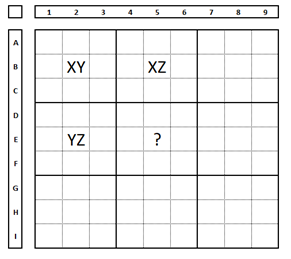
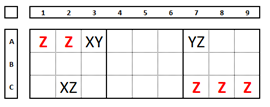
This technique uses 3 bi-value cells. It occurs in the following way: for any choice made in cell B2 (X or Y), either cell B5 will be Z or cell E2 will be Z. Thus, the cell “?” can never be Z, as it sees both cells.
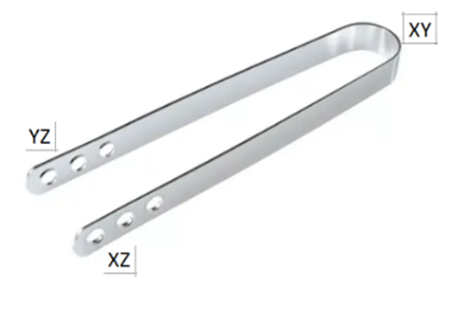
The cell that “sees” the other two is called the “hinge”. The two arms are the “pincers”.
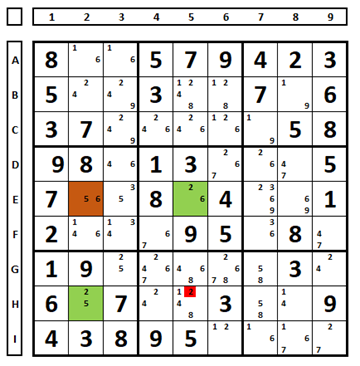
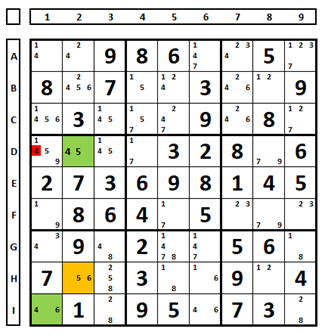
Examinating the Sudoku below, there are numbers (2,5,6) forming bi-value cells in the rows and columns of E2 (hinge), H2 and E5, forming an “L”. The numbers (5,6) in the cell E2 (brown), “see” the numbers (5 or 6) in the cells H2 and E5 (both in green). Whatever the choice in cell E2, either cell E5 or cell H2 will contain the number “2”, so the number “2” can be excluded from cell H5:
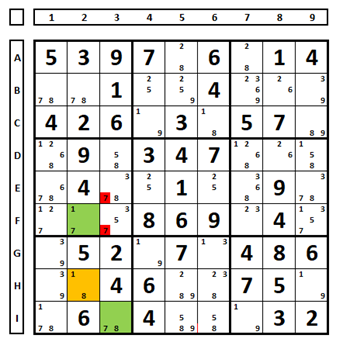
Another example, the brown cell contains the number “5” or “6”, so the number “4” will be in one of the green cells, and can be excluded from cell D1:
Eliminating two candidates, both cells E3 and F3, see the green cells:
Note:
Consider the situation below, for any choice made in cell A3, the “Z” will never occupy the positions marked in red.
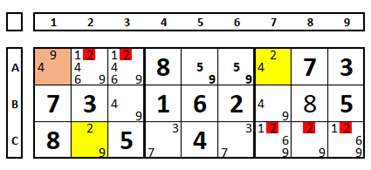
For any choice made in cell A1, the numbers “2” marked in red can be excluded: