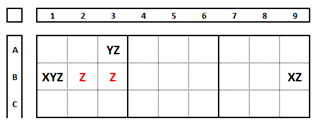
The XYZ cell is the hinge with three candidates and sees the other two cells of the pincer. The other two cells have a number (Z) in common with the hinge. If situations like the ones below occur, the numbers in red can be excluded because they see all three “z’s” that make up the XYZ-wing.
The rule is, the “Z” can be excluded from any cell that “sees” the three cells (XYZ), (XY), and (YZ).
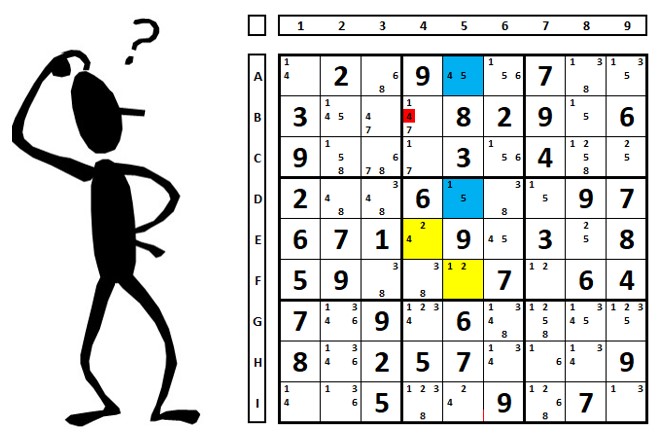
Example. The number “6” in cell E2 “sees” the cells marked and can be excluded:
Example in non-contiguous boxes
XYZ-Wing is a subset of the Almost Locked Set technique, which will be seen later.
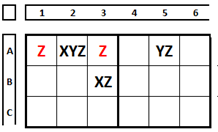
Alert: the situation below does not allow the use of a “false” XYZ-Wing (note that the XYZ cell does not see the cell containing XZ).
The “X”, although “seeing” the three “X” of this “false” XYZ-Wing”, cannot be excluded (if it is excluded, it is a trial and error method).
Example. The number “5” cannot be excluded in cell I9, as it is a solution in this cell: